
Luxury rentals are defined as privately managed, fully furnished residential properties that deliver hotel-caliber finishes with the space, privacy, and flexibility of a personal home. The case for why luxury rentals outperform hotels has never been stronger: professionally managed rentals now earn 46–113% more revenue than individual listings, and travelers in urban markets pay roughly 25% less per night than comparable hotel rooms. These are not marginal gains. They represent a structural shift in how discerning travelers think about accommodation. Families, executives, and group travelers are all moving toward short-term rentals (the industry's standard term for this category), and the data from 2026 confirms the trend is accelerating.
Why luxury rentals outperform hotels on cost and space
The cost advantage of luxury rentals is real and measurable. STR demand outpacing hotels in urban markets translates directly to a 25% cost discount for guests booking professionally managed properties over comparable hotel rooms. That gap widens significantly when you factor in group travel, where a single rental sleeping eight guests costs far less per person than eight separate hotel rooms.
Space is the second major driver. A standard urban hotel room averages 300–400 square feet. A luxury rental in the same city typically delivers 1,500–3,000 square feet across multiple bedrooms, a full living room, and a private kitchen. For a family of five or a corporate team of ten, that difference is not a preference. It is a practical necessity.

The cost math also shifts when you account for what hotels charge separately. Room service, minibar use, parking, and resort fees add up fast. Luxury rentals bundle most of these costs into a single nightly rate, and the ability to cook your own meals eliminates restaurant spending entirely for multi-night stays.
| Accommodation Type | Avg. Nightly Rate (Urban) | Avg. Square Footage | Kitchen Access | Private Parking |
|---|---|---|---|---|
| Standard Hotel Room | Higher per person | 300–400 sq ft | No | Paid extra |
| Luxury Short-Term Rental | ~25% lower per person | 1,500–3,000 sq ft | Yes (full kitchen) | Often included |
| Boutique Hotel Suite | Premium pricing | 600–900 sq ft | Kitchenette only | Rarely included |
Pro Tip: To calculate your true cost, add hotel parking, daily breakfast, and any resort fees to the base rate. Then divide the luxury rental total by the number of guests. The per-person number almost always favors the rental for groups of three or more.
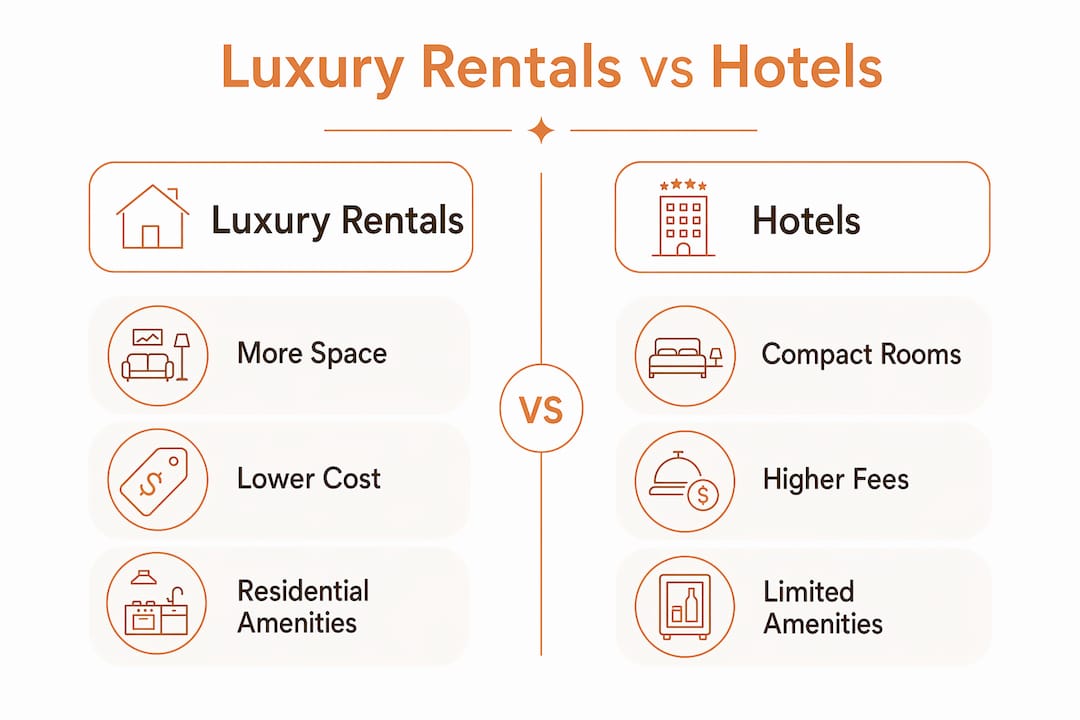
What residential amenities do luxury rentals offer that hotels cannot?
The amenity gap between luxury rentals and hotels is wider than most travelers realize. For stays over 4 nights, luxury rentals outperform hotels specifically because of home-like features that hotels structurally cannot replicate at scale.
The most impactful residential features include:
- Full kitchens stocked with professional cookware, allowing guests to prepare meals, store groceries, and avoid the cost and inconvenience of eating out for every meal
- In-unit laundry that eliminates the need to pack for a week or pay hotel laundry rates, which matter enormously for families and travelers on extended assignments
- Separate living zones including dedicated living rooms, dining areas, and multiple bedrooms that give each guest personal space without sacrificing communal gathering areas
- Private outdoor spaces such as rooftop terraces, patios, and balconies that hotels reserve for premium suites at significant upcharges
- Dedicated workspaces with reliable high-speed internet, which bleisure travelers (those mixing business and leisure) require for productivity during longer stays
The psychological shift this creates is significant. Luxury rental demand psychology research identifies the transition from feeling like a visitor to feeling like a resident as a core driver of repeat bookings among executives and long-term travelers. A hotel room signals temporary displacement. A luxury rental signals that you belong there.
Privacy and security also differentiate the two categories. Luxury rentals offer keyless smart entry, private parking, and no shared corridors or elevators with strangers. Hotels, by design, funnel hundreds of guests through the same lobby, elevator bank, and hallway. For high-profile guests, families with young children, or anyone who values controlled access, the rental model wins on security alone.
Pro Tip: When evaluating a luxury rental, prioritize in-unit laundry, a full-size refrigerator, and dedicated parking above all other amenities. These three features deliver the most practical value on stays of three or more nights.
Who prefers luxury rentals? the demographics behind the shift
The preference for luxury rentals is not evenly distributed across traveler types. The data reveals clear patterns that explain why rental market share has nearly doubled from 8% in 2018 to 15% in 2026. That growth reflects real behavioral change, not just marketing momentum.
Parents traveling with children are the most decisive segment. 65% of parents traveling with children under 18 prefer vacation rentals over hotels, compared to 45% of travelers without children. The gap reflects the practical reality of traveling with kids: you need space to spread out, a kitchen for meals and snacks, and separate sleeping areas so adults and children are not sharing a single room.
| Traveler Segment | Rental Preference | Primary Driver |
|---|---|---|
| Parents with children under 18 | 65% prefer rentals | Space, kitchen, separate sleeping areas |
| Travelers without children | 45% prefer rentals | Cost savings, privacy |
| High-net-worth professionals | Growing preference | Lifestyle flexibility, fixed costs |
| Group and event travelers | Strong preference | Per-person cost, communal spaces |
High-net-worth professionals increasingly choose luxury rentals over hotel suites to maintain capital flexibility and avoid the unpredictability of hotel pricing during peak events. For this segment, the appeal is turnkey living with premium finishes and fixed, transparent costs. Mid-term rental bookings have increased 136% since 2019, a figure that reflects the rise of remote work, extended project assignments, and the bleisure travel category.
Group travelers represent another high-growth segment. Group travel demand keeps luxury rentals resilient while hotels struggle with perishable inventory and inconsistent room configurations. A group of twelve traveling together for a wedding weekend or corporate retreat gets a shared home, not twelve separate rooms with no common space.
Hotels vs. luxury rentals: how do service and experience compare?
Hotels and luxury rentals serve different travel needs, and understanding where each excels helps you make the right call for your specific trip.
Hotels maintain a genuine edge in three areas. First, AI-driven personalization: major hotel brands like Marriott and Hilton use guest data to pre-set room temperature, pillow type, and minibar preferences before you arrive. Second, on-site services: a full-service hotel delivers a spa, concierge, room service, and a fitness center under one roof. Third, short-stay convenience: for a one-night business trip, a hotel's check-in simplicity and proximity to airports or convention centers is hard to beat.
Luxury rentals counter with advantages that matter more as stay length increases:
- No surprise charges: the nightly rate covers the space, and there are no per-item fees for using the kitchen or watching a movie
- Flexibility in check-in and check-out timing, which professionally managed rentals increasingly offer through smart lock systems
- Communal gathering spaces that hotels charge premium rates to access, such as private rooftop terraces and full dining rooms
- Frictionless living with concierge-level support from professional management teams, without the impersonal scale of a 400-room hotel
The emerging model that wins on both fronts is professionally managed luxury rentals. These properties combine hotel-quality maintenance, responsive 24/7 support, and curated interior design with the space and privacy of a private home. Hotels excel for short stays with AI personalization, but luxury rentals surpass them for mid-to-long-term bleisure travel needs. That distinction is the clearest guide to choosing between the two.
How to choose between a luxury rental and a hotel for your trip
The right accommodation depends on your trip length, group size, and what you actually need during your stay. Use this framework to decide.
Choose a luxury rental when:
- Your stay is three or more nights, since the cost and comfort advantages compound with each additional day
- You are traveling with family or a group of three or more people, where per-person cost and shared space both favor the rental
- Your trip includes work requirements, since a dedicated workspace and reliable internet in a private setting outperforms a hotel desk in a shared room
- You need a kitchen, whether for dietary reasons, budget management, or simply the convenience of breakfast without a restaurant bill
- Privacy is a priority, including for high-profile guests, families with young children, or anyone who values controlled, secure access
Choose a hotel when:
- Your stay is one or two nights and you need maximum convenience with minimal setup
- You require on-site amenities like a spa, pool, or 24-hour room service that a rental cannot replicate
- You are traveling solo for a business trip and hotel loyalty points represent meaningful value
- The destination has limited professionally managed rental inventory, making quality control uncertain
For urban stays in cities like Houston, the cost comparison consistently favors rentals for groups. A three-bedroom luxury rental in Rice Military or Midtown Houston at a competitive nightly rate, split among six guests, delivers a per-person cost that no comparable hotel can match. Add private parking, a full kitchen, and a rooftop terrace, and the value gap becomes undeniable. You can explore short-term rental advantages in more detail if you are weighing an extended stay specifically.
Key takeaways
Luxury rentals outperform hotels by delivering more space, lower per-person costs, and residential amenities that matter most for stays of three or more nights, group travel, and bleisure trips.
| Point | Details |
|---|---|
| Cost advantage is real | Professionally managed luxury rentals offer a 25% cost discount over hotels in urban markets. |
| Space drives satisfaction | Luxury rentals deliver 1,500–3,000 sq ft versus a hotel's 300–400 sq ft for a comparable price. |
| Families lead the shift | 65% of parents with children under 18 prefer rentals, driving market share from 8% to 15% since 2018. |
| Amenities change the math | Full kitchens, in-unit laundry, and private parking eliminate costs hotels charge separately. |
| Trip length is the deciding factor | Rentals outperform hotels on stays of three or more nights; hotels win for one-to-two-night convenience. |
The accommodation shift nobody is talking about honestly
I have spent years watching travelers agonize over the hotel-versus-rental decision as if it were a coin flip. It is not. The honest answer is that hotels have not fundamentally changed their value proposition in decades. They have added apps and loyalty programs, but the core product is still a 350-square-foot room with a minibar you are afraid to touch and a parking fee that shows up as a surprise on checkout.
What has changed is the quality floor for luxury rentals. Five years ago, booking a high-end rental meant accepting inconsistency. Today, professionally managed properties operate with hotel-level maintenance standards, smart security, and responsive support teams. The gap in service reliability has closed. The gap in space and cost has not.
The misconception I hear most often is that luxury rentals are only worth it for large groups. That is wrong. A solo executive or a couple on a five-night trip gets enormous value from a private kitchen, a real living room, and the ability to work without a hotel desk chair cutting off circulation. The lifestyle upgrade is real at any group size, as long as the stay is long enough.
My advice: stop treating accommodation as a commodity decision. The right rental in the right neighborhood changes the entire texture of a trip. For Houston specifically, being in Rice Military with a rooftop view and a chef's kitchen is a fundamentally different experience than a hotel corridor on the convention center block. If you are evaluating family vacation rentals vs. resorts, the space and cost arguments are even more pronounced.
— Michael
Experience houston differently with 539Rentals
539Rentals offers a portfolio of professionally managed luxury properties in Houston's most sought-after neighborhoods, including Rice Military, Montrose, and Midtown. Properties like The Pinnacle, The Eterne, The Onyx, and The Horizon deliver private rooftop terraces, chef-ready kitchens, in-suite laundry, and smart keyless access as standard features. The portfolio scales from intimate 3-bedroom townhomes to 16-bedroom multi-home packages sleeping up to 40 guests, making 539Rentals the right fit for couples, families, corporate teams, and large group celebrations alike. 539Rentals is also proudly pet-friendly, so your whole family travels together.

Guests who book directly at 539Rentals save up to 20% compared to third-party platforms, with transparent pricing and no hidden fees. Corporate travelers can explore dedicated monthly furnished rentals built for extended assignments. Browse the full portfolio and book your Houston stay at 539rentals.com.
FAQ
Are luxury rentals actually cheaper than hotels?
Professionally managed luxury rentals offer a 25% cost discount over hotels in urban markets. The savings grow further when you divide the rental cost across multiple guests and factor in eliminated expenses like parking, dining, and resort fees.
How long should my stay be to justify a luxury rental?
For stays over 4 nights, luxury rentals consistently outperform hotels on both cost and comfort. For stays of one to two nights, a hotel's convenience may outweigh the rental's space advantage.
Why do families prefer vacation rentals over hotels?
65% of parents traveling with children under 18 prefer vacation rentals, primarily because of separate sleeping areas, full kitchens, and the ability to maintain daily routines without restaurant dependency.
What is the difference between a luxury rental and a standard vacation rental?
A luxury rental is a professionally managed property with premium finishes, curated design, hotel-quality maintenance, and amenities like rooftop terraces, chef kitchens, and smart security systems. Standard vacation rentals vary widely in quality and are often owner-managed without consistent service standards.
Do luxury rentals offer the same security as hotels?
Luxury rentals from professional operators use smart keyless entry, private parking, and secure access systems that limit property access to registered guests only. This level of controlled access often exceeds the shared-corridor security model of traditional hotels.