
Monthly rental pricing for extended stays is defined as a structured rate model that applies discounts to nightly prices in exchange for lower operational costs, predictable cash flow, and reduced turnover. The role of monthly rental pricing in extended stays goes far beyond a simple percentage off. It reflects a fundamentally different business model, one where hosts trade peak nightly revenue for stability, and guests trade flexibility for significant savings. Business professionals on assignment, traveling nurses, remote workers, and corporate relocators all make accommodation decisions based on how well they understand these pricing mechanics. Getting it right means the difference between overpaying and securing a property that genuinely fits your budget and timeline.
How does monthly rental pricing differ from nightly rates?
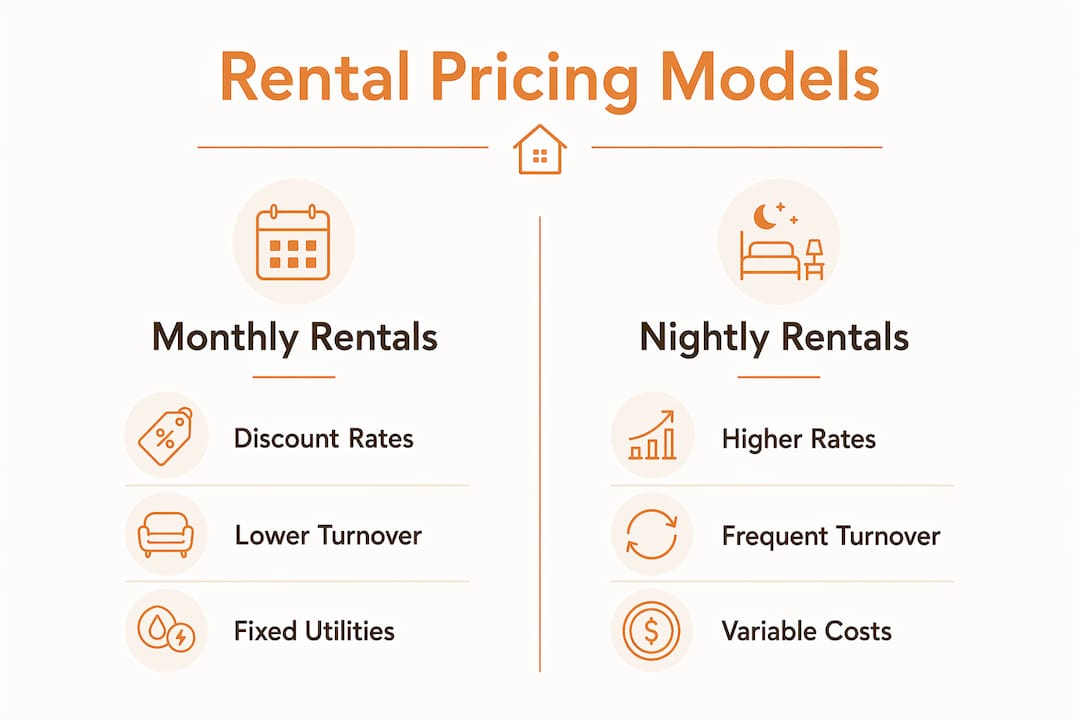
Monthly rental pricing is a distinct cost structure, not just a discounted version of nightly rates. Mid-term rental operating expenses run 20–35% of revenue, compared to 40–60% for short-term nightly rentals. That gap explains why hosts can afford to offer meaningful discounts without losing margin.
The savings come from fewer turnovers, less cleaning, lower restocking costs, and reduced guest communication overhead. A property rented for 30 consecutive days requires one check-in, one checkout, and one deep clean. The same property rented nightly for 30 days requires 30 of each. That operational difference is the engine behind monthly rate discounts.
Here is how the two models compare across key cost categories:
- Turnover frequency: Nightly rentals average 20–30 turnovers per month. Monthly rentals average one.
- Cleaning costs: Short-term cleaning fees are charged per stay. Monthly rentals spread that cost across the full booking period.
- Operating expense ratio: Short-term rentals consume 40–60% of revenue in operating costs. Monthly rentals drop that to 20–35%.
- Cash flow predictability: Monthly rentals deliver guaranteed income for 28+ days. Nightly rentals depend on occupancy rates that fluctuate daily.
- Discount depth: Typical monthly discounts run 30–50% off short-term rates for 28-day stays.
Mid-term rentals yield 53% higher net operating income than short-term rentals despite lower nightly rates. That figure shows why monthly pricing is not a concession. It is a deliberate financial strategy.
Pro Tip: When evaluating a monthly rate, ask the host for the equivalent nightly rate and calculate the total. If the monthly rate saves you less than 25% versus booking nightly, the deal is not competitive for a 30-day stay.
A sound monthly rate starts from a break-even calculation that covers fixed costs plus variable turnover costs, targeting 40–60% of what the property would earn at average nightly occupancy. Travelers who understand this framework can quickly assess whether a quoted monthly rate is fair or inflated.

What factors affect monthly rental rates for extended stays?
Monthly rental rates are shaped by at least five distinct variables, and ignoring any one of them leads to poor pricing decisions on both sides of the transaction.
-
Guest demographics and channel. Price sensitivity varies significantly by guest type. Travel nurses prioritize affordability and often have fixed housing stipends. Remote workers carry more budget flexibility. Corporate travelers on company accounts focus on amenity quality over rate. Hosts who understand their primary guest channel set rates accordingly, and travelers who know their segment can negotiate from a position of knowledge.
-
Included utilities and furnishings. Furnished mid-term rentals command a 25–55% premium over comparable unfurnished long-term rentals. That premium covers furniture depreciation, appliance maintenance, kitchenware, linens, and often utilities. A furnished rental at $3,500 per month that includes electricity, water, and Wi-Fi may cost less than an unfurnished apartment at $2,200 per month once you add setup costs and utility bills.
-
Utility consumption buffers. Extended stay guests consume 15–20% more utilities than short-term visitors because they cook, work, and live in the space full time. Responsible pricing models either embed a utility buffer in the base rate or charge overages above a set allowance. Travelers should ask upfront which model applies.
-
Seasonality and dynamic pricing. Demand for extended stays spikes during major events, corporate conference seasons, and medical treatment cycles. Properties near Houston's Texas Medical Center, for example, see consistent demand from patients and families regardless of season. Dynamic pricing models adjust monthly rates based on local occupancy trends, so booking during shoulder periods can yield better rates.
-
Location and comparable benchmarks. Properties in high-demand urban neighborhoods command premiums that reflect walkability, proximity to employment centers, and access to transit. Comparing a monthly rate against local long-term unfurnished rental benchmarks gives you a reliable anchor for negotiation.
Common mistakes in monthly rental pricing strategies
The most costly mistake travelers and hosts both make is applying short-term pricing logic to monthly rentals. A host who simply multiplies a nightly rate by 30 and offers a 10% discount has not built a monthly pricing model. They have built an overpriced monthly rate that will sit vacant.
Applying short-term pricing logic to monthly rentals ignores the operational savings that justify the discount. Recommended tiered discounts run 5–10% for stays over 60 or 90 days, layered on top of the base monthly discount. Blanket discounts applied uniformly across all booking lengths leave money on the table at shorter durations and undervalue longer commitments.
- Skipping the utility buffer. A monthly rate that does not account for higher utility consumption erodes host margins and often leads to surprise charges for guests.
- Ignoring tiered structures. Tiered pricing with moderate discounts outperforms blanket discounts in diverse demand markets. A 7-13 day tier, a 14-27 day tier, and a 28+ day tier each capture different guest segments at appropriate price points.
- Overlooking negotiation leverage. Travelers with a booking history or volume commitment have real negotiating power. Most do not use it.
- Accepting OTA-listed rates as final. Direct negotiation months in advance and volume booking history can unlock rates not available on any listing platform.
Pro Tip: Before committing to a monthly rate, ask the property manager directly whether they offer a lower rate for a 60-day or 90-day commitment. The answer is often yes, and the savings can be substantial.
How can travelers use monthly pricing insights to choose better accommodations?
Understanding extended stay pricing strategies gives travelers a concrete framework for comparing options that look similar on the surface but differ significantly in total cost.
The first step is separating all-inclusive rates from utility-separate rates. A property listed at $2,800 per month with utilities included may cost less than one listed at $2,400 per month where electricity, water, and internet add another $400–$600. Always calculate the fully loaded monthly cost before comparing.
| Accommodation type | Typical monthly discount | Utilities included | Furnishings | Best for |
|---|---|---|---|---|
| Extended-stay hotel | Up to 60% for 60+ nights | Usually yes | Yes | Short corporate trips |
| Serviced apartment | 20–35% off nightly | Often yes | Yes | Mid-term professionals |
| Furnished private rental | 30–50% off nightly | Varies | Yes | Remote workers, families |
| Unfurnished long-term rental | Market rate | No | No | Relocators with furniture |
Extended-stay hotels offer up to 60% discounts for stays of 60 or more consecutive nights. That is a strong benchmark for travelers evaluating furnished private rentals. If a private rental's monthly rate does not beat an extended-stay hotel's 60-night rate on a total-cost basis, the private rental needs to justify the gap through space, privacy, or amenity quality.
Timing matters too. Booking 2–4 weeks in advance secures the best rates for stays of a week or more. For monthly stays, booking 6–8 weeks out and negotiating directly with the property manager gives you the most leverage. You can also reference comparable listings in the same neighborhood to anchor your negotiation.
The short-term rental versus extended hotel stay comparison often favors furnished private rentals for stays beyond 14 days, particularly when kitchen access, laundry, and private outdoor space factor into the equation. Understanding the long-term rental budget mechanics in your target city sharpens that comparison further.
Key Takeaways
Monthly rental pricing for extended stays works because lower operational costs justify meaningful discounts, and travelers who understand the underlying math negotiate better rates and avoid overpaying.
| Point | Details |
|---|---|
| Monthly pricing is a distinct model | Operating costs drop to 20–35% of revenue versus 40–60% for nightly rentals. |
| Tiered discounts outperform blanket ones | Structure discounts by stay length (7–13, 14–27, 28+ days) to capture full value. |
| Utilities change the true cost | Always calculate the fully loaded monthly cost, including electricity, water, and internet. |
| Direct negotiation unlocks better rates | Booking history and volume commitments secure rates below any OTA-listed price. |
| Guest type shapes the right rate | Travel nurses, remote workers, and corporate travelers each respond to different pricing signals. |
What I have learned about monthly pricing that most guides miss
Most articles on extended stay pricing focus on the discount percentage and stop there. That framing misses the real story. The discount is a byproduct of cost structure, not a marketing decision. When you understand that monthly rentals run at 20–35% operating cost ratios versus 40–60% for nightly rentals, you stop asking "how much of a discount should I expect" and start asking "what is this property actually worth at 30 days."
The utility question is the most overlooked variable I see travelers ignore. A $200 per month difference in base rate can evaporate instantly if the property charges electricity overages. I have seen travelers commit to a monthly rate that looked competitive, then receive a utility bill that pushed their effective cost above what a fully inclusive option would have charged. Always ask for the utility policy in writing before signing anything.
The negotiation point is equally underused. Most travelers treat the listed monthly rate as fixed. It rarely is. Property managers with a vacancy to fill in the next 30 days will negotiate. Travelers with a confirmed booking history, a longer commitment, or a corporate account have real leverage. Use it. The worst answer you will get is no, and the best answer saves you hundreds of dollars per month.
My honest view is that the travelers who get the most value from extended stays are the ones who treat accommodation selection like a procurement decision. They compare total costs, ask hard questions about what is included, and negotiate directly. That approach works whether you are booking a furnished townhome in Houston or a serviced apartment anywhere else.
— Michael
Extended stays in Houston done right with 539Rentals
Travelers and business professionals who want monthly pricing that is transparent, competitive, and backed by premium accommodations will find exactly that at 539Rentals. Properties like The Pinnacle, The Eterne, and The Onyx in Rice Military offer chef-ready kitchens, private rooftop terraces, in-suite laundry, and dedicated parking. These are not hotel rooms with a kitchenette. They are fully furnished residences built for guests who need a real home base for weeks or months at a time.

539Rentals' corporate housing program is purpose-built for extended stays, with flexible monthly rates, direct booking savings of up to 20% versus third-party platforms, and 24/7 guest support. Booking directly at 539rentals.com gives you transparent pricing, no platform markups, and the ability to negotiate terms that fit your specific timeline and needs.
FAQ
What is monthly rental pricing for extended stays?
Monthly rental pricing for extended stays is a rate model that applies discounts to standard nightly prices based on the operational savings generated by longer, lower-turnover bookings. It is a distinct pricing structure, not simply a nightly rate multiplied by 30.
How much of a discount should I expect on a monthly rental?
Typical monthly rental discounts run 30–50% off short-term nightly rates for 28-day stays, depending on the property type and market. Extended-stay hotels can offer up to 60% off for stays of 60 or more consecutive nights.
Are utilities always included in monthly rental rates?
Utilities are not always included. Some properties embed a utility buffer in the base rate, while others charge overages above a set allowance. Always confirm the utility policy before committing to a monthly rate to calculate your true total cost.
Can I negotiate a monthly rental rate below the listed price?
Direct negotiation with property managers, especially when you have a booking history or a longer commitment, regularly produces rates below any listed price. Booking 6–8 weeks in advance and referencing comparable local listings strengthens your negotiating position.
How does guest type affect monthly rental pricing?
Travel nurses typically seek the lowest available rate within a fixed housing stipend, while remote workers and corporate travelers carry more budget flexibility. Property managers who understand their primary guest channel set and adjust rates accordingly, which means travelers who know their segment can negotiate more effectively.