
Effective long-term rental budget management in Houston is defined as the disciplined practice of tracking all property expenses, modeling conservative income assumptions, and maintaining adequate cash reserves to sustain positive cash flow across market cycles. Houston's rental market presents specific financial pressures that most generic budgeting guides ignore: Harris County property taxes that reassess annually without a homestead cap, flood insurance requirements that vary by FEMA zone, and a 2026 rental market where average single-family lease prices have dipped 2.6% while inventory grows. Getting your numbers right from the start is not optional. It is the difference between a property that builds wealth and one that quietly drains it.
How to manage long-term rental budget Houston: the essential cost components
Managing rental expenses in Houston starts with knowing exactly what you are budgeting for. Most landlords underestimate total costs by focusing only on mortgage and rent, missing the layered expenses that determine whether a property actually earns money.
The six core cost categories every Houston rental budget must include are:
- Mortgage principal and interest. This is your largest fixed cost and the baseline for every cash-flow calculation. Model it at the actual loan terms, not a best-case scenario.
- Harris County property taxes. Tax rates in Harris County commonly run 2.1% to 2.8% of assessed value for investors, with no homestead exemption to cap annual increases. A $300,000 property can carry a tax bill above $7,000 per year. Budget for 3% to 5% annual escalation.
- Insurance, including flood coverage. Standard landlord policies exclude flood damage. Flood insurance must be budgeted separately based on FEMA zone classification, and premiums vary significantly under FEMA Risk Rating 2.0. Do not assume your standard policy covers a Houston flood event.
- Maintenance and capital expenditure reserves. HVAC systems, roofs, plumbing, and appliances all fail eventually. A sound underwriting checklist recommends holding 6 to 12 months of reserves and stress-testing for capital expenditure surprises.
- Property management fees. Professional managers in Houston charge 8% to 12% of monthly rent plus leasing fees of 50% to 100% of one month's rent per placement. Annual cost typically lands between $2,000 and $3,500 per property.
- Vacancy and turnover costs. Every week a unit sits empty costs you rent, plus you face make-ready repairs, cleaning, landscaping, and marketing expenses before the next tenant moves in.
The table below shows how these costs stack up for a representative Houston single-family rental at $2,274 per month (the April 2026 market average):
| Cost category | Estimated monthly budget |
|---|---|
| Mortgage (principal + interest) | $1,100 to $1,500 |
| Property taxes (escrowed monthly) | $580 to $700 |
| Insurance (landlord + flood) | $150 to $250 |
| Maintenance and capex reserve | $150 to $230 |
| Property management fee (10%) | $227 |
| Vacancy reserve (5% of rent) | $114 |
Running these numbers before you sign a lease or purchase a property tells you whether the deal works. If the total exceeds projected rent, you have a negative cash-flow property, not an investment.
How do you set up a disciplined budgeting process for Houston rentals?
A disciplined budgeting process for long-term lease financial planning follows four concrete steps. Skipping any one of them creates blind spots that show up as cash-flow surprises.
- Categorize and reconcile monthly. Use dedicated property accounts for each rental, separating rent income from personal funds. Reconcile every expense against your budget categories before the end of each month. This practice catches billing errors, flags rising costs early, and gives you clean data for tax time.
- Model conservative rent and vacancy assumptions. Do not budget at 100% occupancy. A 5% vacancy allowance is a minimum in Houston. Given that days on market are lengthening in 2026, a 7% to 8% vacancy buffer is more realistic for properties in slower submarkets.
- Maintain 6 to 12 months of cash reserves. Reserves are not optional in Houston. A single HVAC replacement, a flood event, or a contested eviction can cost $5,000 to $15,000. Reserves prevent those events from forcing you to sell or take on debt.
- Escrow for property taxes even if your lender does not require it. Harris County tax bills arrive once a year, but the expense accrues every month. Divide your projected annual tax bill by 12 and set that amount aside in a dedicated account each month. This eliminates the annual shock of a $7,000-plus payment.
For ongoing tracking, tools like Stessa, Buildium, and QuickBooks Self-Employed each handle rental property accounting differently. Stessa is free and built specifically for landlords. Buildium suits portfolios of five or more units. QuickBooks works well if you already use it for other business finances.
Pro Tip: Recheck your property's FEMA flood zone status every two to three years. Houston flood maps are updated regularly, and a zone change can alter your insurance requirement and premium significantly. A reclassification from Zone X to Zone AE can add hundreds of dollars per year to your budget.

Why is tenant turnover the biggest threat to your rental budget?
Tenant turnover is the single largest profit killer for Houston landlords, and most budgets treat it as a one-line vacancy cost when it is actually a multi-cost chain reaction. Understanding the full cost picture changes how aggressively you invest in retention.
Here is what a single turnover event actually costs:
- Lost rent during vacancy. Even two weeks empty on a $2,274 unit costs over $1,100 in lost income.
- Make-ready expenses. Cleaning, paint touch-ups, carpet cleaning, minor repairs, and landscaping typically run $500 to $2,000 depending on tenant condition.
- Leasing fees. If you use a property manager, expect to pay 50% to 100% of one month's rent to place a new tenant.
- Utility carry. You pay electricity, water, and gas while the unit sits vacant.
- Marketing costs. Photography, listing fees, and showing time add up, especially in a market where days on market are increasing.
Compare that to what tenant retention actually costs:
| Expense type | Turnover scenario | Retention scenario |
|---|---|---|
| Vacancy loss (2 weeks) | $1,137 | $0 |
| Make-ready repairs | $800 to $2,000 | $200 to $500 (routine maintenance) |
| Leasing fee | $1,137 to $2,274 | $0 |
| Marketing | $100 to $300 | $0 |
| Total estimated cost | $3,174 to $5,711 | $200 to $500 |
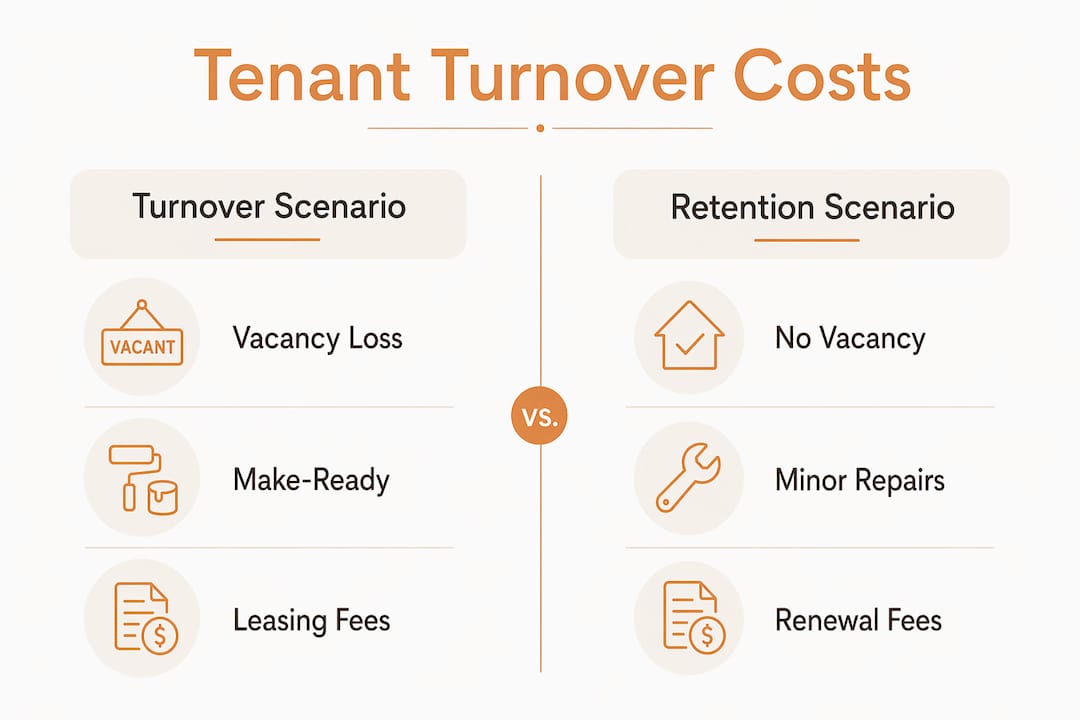
The math is clear. Proactive tenant retention reduces vacancy, marketing, and maintenance expenses over time, directly improving your net operating income. Small investments in tenant satisfaction, such as fast maintenance responses and reasonable renewal terms, pay back many times over.
Pro Tip: Send renewal offers 90 days before lease expiration, not 30. Tenants who feel rushed or uncertain about their housing often start apartment hunting out of anxiety, not dissatisfaction. Early outreach signals stability and gives you time to negotiate without scrambling to fill a vacancy.
Professional property management vs. self-management: which is better for your budget?
The decision to hire a property manager or self-manage is a financial tradeoff that depends on your time, risk tolerance, and portfolio size. It is not simply a question of saving the management fee.
Professional property management in Houston typically costs:
- Monthly management fee: 8% to 12% of collected rent
- Leasing fee: 50% to 100% of one month's rent per new tenant placement
- Annual cost per property: approximately $2,000 to $3,500
That fee buys you more than administration. A competent manager reduces vacancy periods through faster marketing and tenant screening, handles maintenance coordination that prevents small issues from becoming expensive repairs, and manages legal compliance that protects you from costly eviction errors.
| Factor | Professional management | Self-management |
|---|---|---|
| Monthly cost | $180 to $275 (at 8%–12% of $2,274) | $0 direct cost |
| Vacancy risk | Lower with professional marketing | Higher without dedicated resources |
| Maintenance response | Faster with vendor networks | Dependent on your availability |
| Legal compliance | Managed by professionals | Your responsibility |
| Time investment | Minimal | 5 to 10 hours per month per property |
Self-management makes financial sense if you have local availability, maintenance skills, and only one or two properties. For investors managing multiple Houston properties or those living outside Harris County, management fees as a budget tradeoff are almost always worth the operational value they deliver.
How do 2026 Houston rental market trends affect your budget assumptions?
The April 2026 Houston rental market data from HAR shows a 2.6% dip in average single-family lease prices alongside a 9.7% increase in leases signed and 1.9% growth in rentable inventory. That combination means more competition for tenants, longer days on market, and downward pressure on rents in some segments. For your budget, this translates directly into higher vacancy risk and reduced income assumptions.
Townhome and condo rentals showed more price stability than single-family homes in the same period. If you are selecting a submarket or property type, this data supports favoring higher-density urban product in neighborhoods with strong employment access, such as Midtown, Montrose, and the areas around the Texas Medical Center. Stress-testing your income projections at 5% below current market rent is a sound practice given these conditions. A budget that only works at peak rent is not a budget. It is a bet.
Key takeaways
Disciplined long-term rental budget management in Houston requires separating fixed, variable, and reserve expense layers so that no single unexpected cost collapses your cash flow.
| Point | Details |
|---|---|
| Budget all six cost categories | Include mortgage, taxes, insurance, maintenance, management fees, and vacancy in every projection. |
| Escrow for property taxes monthly | Harris County rates of 2.1% to 2.8% with annual reassessment require monthly set-asides to avoid cash-flow shocks. |
| Treat turnover as a multi-cost event | A single tenant turnover can cost $3,000 to $5,700 when all layered expenses are counted. |
| Maintain 6 to 12 months in reserves | Houston's flood risk and tax variability make reserves a non-negotiable budget line, not a luxury. |
| Stress-test against 2026 market data | Model income at 5% below current market rent given inventory growth and longer days on market. |
What managing Houston rentals actually taught me
Most landlords I have spoken with in Houston underestimate their property tax exposure in year two and three. They budget based on the purchase-year assessment, then get blindsided when Harris County reassesses upward after a strong market year. The fix is simple: model 3% to 5% annual tax growth from day one and treat any year where taxes stay flat as a bonus, not the baseline.
The other pattern I see consistently is treating flood insurance as optional until it is not. Houston has flooded three times in three years within living memory. Flood zone maps shift, and a property that was Zone X when you bought it may be Zone AE by the time a storm hits. Checking your FEMA status annually costs nothing. Skipping that check can cost everything.
My strongest advice for anyone managing Houston rentals is this: run your property like an active business, not a passive income stream. That means monthly reconciliations, proactive tenant communication, and a written reserve policy you actually follow. The landlords who build real wealth here are not the ones who found the best deal. They are the ones who managed the numbers with discipline after the deal closed. You can explore corporate housing options in Houston to see how professionally managed properties handle these cost structures in practice.
— Michael
How 539 Rentals supports smarter Houston rental decisions

If you are evaluating Houston's rental market and want to see what professionally managed, fully furnished properties look like in practice, 539 Rentals offers a portfolio of luxury townhomes and multi-bedroom residences in Rice Military, Montrose, and Midtown. Every property is managed with the kind of cost discipline this article describes: optimized occupancy, fast maintenance response, and transparent pricing. Booking directly at 539rentals.com saves up to 20% compared to third-party platforms, and the full property listings show exactly what premium Houston rental management looks like from the guest side.
FAQ
What are typical property tax rates for Houston rental investors?
Harris County property tax rates for investors commonly range from 2.1% to 2.8% of assessed value, with no homestead exemption cap. Budget for 3% to 5% annual increases to avoid cash-flow surprises.
Does standard landlord insurance cover flood damage in Houston?
No. Flood insurance is excluded from standard landlord policies and must be purchased separately. Premiums depend on your property's FEMA flood zone classification under Risk Rating 2.0.
How much does tenant turnover actually cost Houston landlords?
A single turnover event costs an estimated $3,174 to $5,711 when you account for vacancy loss, make-ready costs, leasing fees, and marketing expenses. Retention investments are almost always cheaper.
What cash reserves should I hold for a Houston rental property?
A sound Houston underwriting approach recommends 6 to 12 months of operating expenses in reserve, stress-tested against capital expenditure, tax increases, and extended vacancy scenarios.
Is professional property management worth the cost in Houston?
For most investors, yes. Management fees of 8% to 12% typically pay for themselves through reduced vacancy periods, faster maintenance resolution, and lower legal risk, especially for landlords managing more than two properties or operating remotely.